

Eczema Keeps You Awake. Then Being Awake Makes Eczema Harder
If you've ever had a bad night's sleep and woken up feeling as though your eczema has joined you in having a terrible night, you probably aren't imagining it.
Perhaps your skin looks redder. Maybe you're itchier than usual. Or perhaps you're simply exhausted and suddenly resisting the temptation to scratch feels considerably harder than it did yesterday.
The relationship between eczema and sleep can become a frustrating two-way street.
Eczema can make getting a good night's sleep extremely difficult. Itching wakes you up, scratching keeps you awake and, before you know it, you're staring at the clock wondering how you're supposed to function tomorrow.
But there's another side to the story.
Poor sleep can also affect stress, inflammation, our ability to cope with itching and some of the processes our bodies rely on to recover.
Which creates a particularly unfair cycle:
Eczema disrupts sleep → poor sleep makes eczema harder to manage → eczema disrupts sleep again.
So, how do we break it?
Your Skin Doesn't Switch Off When You Go to Sleep
Sleep might look like eight hours of doing absolutely nothing, but your body would disagree.
While you're asleep, an enormous amount is going on behind the scenes. Sleep supports immune function, hormone regulation and the body's normal repair processes.
Your skin is part of that.
For somebody with eczema, the skin barrier is already more vulnerable than it should be. It struggles to retain moisture effectively and is more susceptible to irritation.
A good night's sleep isn't a treatment for eczema, but consistently poor sleep may make it harder for your body to perform the normal restorative processes that support healthy skin.
That's one reason sleep deserves to be thought of as part of the wider eczema picture rather than simply something eczema unfortunately interrupts.
Poor Sleep and Inflammation
Eczema is an inflammatory skin condition.
And sleep and inflammation are closely connected.
Research suggests that insufficient or disrupted sleep can influence inflammatory activity in the body. One terrible night's sleep isn't necessarily going to produce an enormous eczema flare the following morning, but repeatedly sleeping badly certainly isn't ideal when you're already managing an inflammatory condition.
There's also an awkward irony here.
As we explain in our guide to why eczema is worse at night, eczema itself can make sleep harder through increased itching, changes in skin temperature and overnight dryness.
Your inflammation contributes to poor sleep.
Then poor sleep may contribute to the conditions that make inflammation harder to manage.
It's easy to see how people become stuck.

Then There's Stress
We've probably all experienced the emotional difference between ourselves after eight hours of sleep and ourselves after four.
Small problems suddenly feel enormous.
Patience disappears.
Concentration becomes difficult.
And everything feels slightly more irritating than it should.
Living with eczema is already stressful. Add sleep deprivation and your ability to cope with that stress can become considerably weaker.
Stress itself can be an eczema trigger for some people, meaning another cycle can emerge:
Eczema → poor sleep → stress → worse eczema → even poorer sleep.
And if you've been through several consecutive nights of itching and broken sleep, being told to “just relax” isn't exactly helpful.
The goal isn't to eliminate stress entirely.
It's to recognise that sleep, stress and eczema aren't three completely separate problems. They can feed into each other.
Being Tired Can Make Scratching Harder to Control
This part is easily overlooked.
During the day, we often have some conscious control over scratching.
You feel an itch and perhaps catch yourself before your fingernails reach your skin.
But self-control is harder when you're exhausted.
If you're tired, stressed and already uncomfortable, resisting that incredibly tempting scratch can become more difficult.
Then comes the familiar itch-scratch cycle.
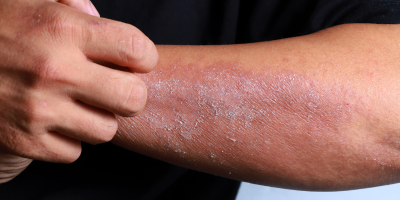
Scratching temporarily relieves the itch but can damage the skin barrier, creating more irritation and inflammation and ultimately another reason to scratch.
We've looked at this in more detail in our article about how clothing can trigger the itch-scratch cycle.
And, of course, scratching doesn't necessarily stop once you finally fall asleep.
Our companion article on why eczema sufferers scratch unconsciously through the night explores exactly why that happens.
So even when you technically spend eight hours in bed, eczema can mean the quality of that sleep is nowhere near what you need.

Eight Hours in Bed Doesn't Always Mean Eight Hours of Good Sleep
This is an important distinction.
You might go to bed at 11pm and get up at 7am and assume you've slept for eight hours.
But eczema-related itching can cause repeated awakenings and scratching throughout the night, some of which you might not even remember the following morning. Sleep experts note that people naturally move through periods of lighter sleep and brief arousals, during which itching and scratching can intrude.
So the issue isn't always simply how long you're in bed.
It's the quality and continuity of the sleep you're getting.
If eczema repeatedly drags you out of deeper sleep, you may wake up feeling exhausted despite apparently spending plenty of time in bed.
How Do We Break the Eczema-Sleep Cycle?
There's unfortunately no single trick that guarantees eight uninterrupted hours.
But we can try to give our skin—and ourselves—the best possible chance.
Start Before You Get Into Bed
A consistent evening routine can help signal that it's time to wind down.
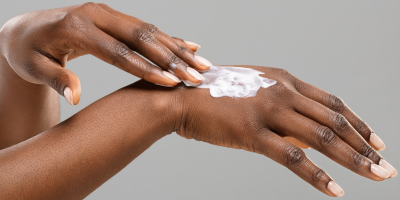
Follow the skincare or treatment plan recommended for your eczema, moisturise as advised and try to avoid going to bed already overheated.
Our article Preparing for Better Sleep, Then Letting Go looks at ways of creating a calmer transition into sleep.
Keep Things Cool
Heat and sweating can make eczema itching considerably more uncomfortable.
A cooler bedroom, breathable bedding and lightweight sleepwear can therefore make a difference for some people.
Our Anti-Scratch Organic Cotton PJ Set uses breathable organic cotton to help protect sensitive skin without unnecessarily trapping heat.
For more on the bedding itself, see our Guide to Better Sleep: Choosing the Right Bedding for Eczema Relief.
Protect Yourself From Night-Time Scratching
Sometimes the problem isn't falling asleep.
It's what your hands do afterwards.
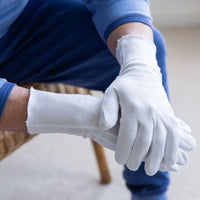
Our Adult Eczema Scratch Mitten T has integral mittens designed to put a soft layer between your fingernails and your skin while you sleep.
For children, our Kids' Eczema Scratch Mitten T uses the same basic principle.
These products aren't treatments for eczema. Instead, they're designed to help reduce the damage unconscious scratching can cause while giving irritated skin a better opportunity to settle.
Make Sleep a Priority, Not an Afterthought
When eczema is bad, it's easy to become obsessed with what you're putting on your skin.
Which cream?
Which moisturiser?
Which treatment?
Which fabric?
Those things can obviously matter enormously.
But sleep deserves a place in that conversation too.
Try to keep reasonably consistent sleep and waking times, give yourself time to wind down and avoid treating sleep as something you'll catch up on eventually.
The Cruellest Eczema Cycle Might Be One We Don't Talk About Enough
Eczema makes you itch.
The itching stops you sleeping.
Being exhausted makes everything about eczema harder to manage.
And then you have to do the whole thing again the following night.
It's a miserable cycle when you're trapped inside it.
But understanding that relationship gives us another way of thinking about eczema management.
Getting better sleep won't cure eczema.
Nor will organic cotton pyjamas, a cooler bedroom or the perfect evening routine.
But if better sleep helps your body recover, makes stress easier to manage and gives you more energy to look after your skin the following day, it's far from irrelevant.
Sometimes managing eczema isn't about finding one miraculous solution.
It's about removing as many little problems as possible.
And getting a decent night's sleep might be one of the most important places to start.