

There are few things more frustrating than going to bed with your eczema relatively under control, only to wake up the following morning and discover that your sleeping self had other ideas.
Perhaps you've scratched an area that had finally started healing. Maybe you've woken up with blood on the sheets or skin underneath your fingernails. Worst of all, you might have absolutely no memory of doing it.
If you've spent the entire day consciously resisting the urge to scratch, it can feel particularly unfair.
So why does it happen?
Unconscious scratching is something many people with eczema experience, and it isn't simply a case of lacking self-control. A combination of increased night-time itching, the natural changes happening in our skin and body overnight, and the simple fact that we're asleep can make scratching much harder to control.
Why Can Eczema Feel Itchier at Night?
Changes in skin temperature, moisture loss and your body’s daily rhythms may contribute to night-time itching. Warm bedding and products your skin reacts to can also affect comfort.
Read our separate guide to why eczema is worse at night for the full explanation. Here, we’ll focus on why you can scratch without remembering it.
Why Can't We Just Stop Ourselves Scratching?
During the day, scratching isn't always completely automatic.
You feel an itch. Your hand moves towards it. Then you catch yourself.
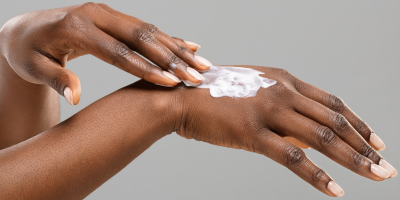
You might put your hands in your pockets, apply moisturiser or simply tell yourself not to do it.
When you're asleep, that conscious intervention isn't necessarily there.
Scratching can happen during periods of lighter sleep or brief awakenings that you don't remember the following morning. Your brain is still capable of responding to an irritating sensation even though you're not fully awake.
Think about how you might turn over, pull the duvet back when you're hot or move a pillow without remembering doing any of it.
Scratching can become another automatic response.
And unfortunately, eczema provides plenty of itchy signals for your sleeping brain to respond to.

The Itch-Scratch Cycle Doesn't Go to Sleep When You Do
This is where things can become particularly frustrating.
Scratching feels good for a reason.
For a few moments it can overwhelm the itchy sensation and provide relief. The problem is what happens afterwards.
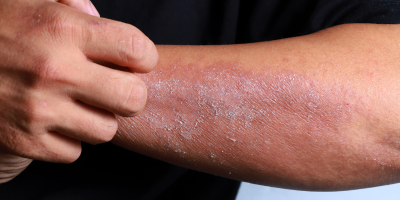
Scratching can damage an already vulnerable skin barrier. That damage can increase inflammation and irritation, which creates more itching.
And so we arrive at the famous eczema itch-scratch cycle:
Itch → Scratch → Skin Damage → More Inflammation → More Itch
We've explored this in more detail in our guide to how clothing can trigger the eczema itch-scratch cycle.
At night this cycle can be especially difficult because you may repeat it several times without properly waking up.
You itch.
You scratch.
You briefly settle.
Your damaged skin becomes irritated again.
And your hand goes straight back.
By morning, an area that looked reasonably calm when you went to bed can look completely different.
Heat and Sweat Can Make Things Worse
Anyone who has experienced an eczema flare during hot weather will probably recognise this one.
Overheating and sweating can make itchy skin extremely uncomfortable.
A warm bedroom, heavy bedding or nightwear that makes you sweaty can add to discomfort. Choosing comfortable layers may help avoid making an existing itch worse.
Explore our adult eczema nightwear and kids’ eczema nightwear for soft clothing designed with sensitive skin in mind.
Clothing cannot stop eczema itching altogether, but it can help minimise everyday rubbing and overheating.

Why Scratch Mittens Can Help When Willpower Can't
Telling somebody not to scratch in their sleep isn't particularly useful advice.
They're asleep.
Instead, it can make more sense to reduce the damage scratching can cause.
Our Adult Eczema Scratch Mitten T was designed specifically with this problem in mind. The 100% organic cotton top has integral mittens that cover the hands overnight, alongside flat internal seams and no irritating internal labels.
For children, the Kids' Eczema Scratch Mitten T works on the same principle, helping protect sore skin from fingernails during unconscious night-time scratching.
There is also an Open Hand Adult Scratch Mitten T for people who want the option of freeing their hands when needed.
Again, none of these products can remove the underlying eczema.
What they can do is create a softer barrier between your nails and your skin when you're not awake to stop yourself.
Sometimes damage limitation is every bit as important as prevention.
Can You Reduce Unconscious Scratching?
You cannot consciously control every movement you make while asleep. However, managing your eczema and reducing skin irritation may help, while short, smooth fingernails and suitable hand coverings may limit scratching damage.
For practical steps covering skin care, bedroom comfort and scratch protection, read our guide to how to stop eczema itching at night.
You can also read about creating an eczema bedtime routine.
Don't Underestimate the Effect on Sleep
There's another side to unconscious scratching that deserves attention.
You might think you've slept for seven or eight hours because you don't remember waking up, but repeated scratching and brief awakenings can fragment sleep.
That matters.
Poor sleep can leave you exhausted and stressed the following day. Then you have to manage eczema while tired, before potentially facing another disrupted night.
If night-time itching regularly disrupts your sleep or scratching leaves your skin sore or broken, speak to your GP or dermatology team. Seek medical advice promptly if you think your skin may be infected.
Your Sleeping Self Isn't Trying to Sabotage You
Perhaps this is the most important thing to remember.
Waking up to find you've scratched skin you'd spent days trying to heal can be incredibly frustrating.
But unconscious scratching isn't the same as deciding to scratch.
The aim is to support your skin and reduce scratching damage, rather than blame yourself for something you cannot consciously control. If this keeps happening, ask for help reviewing your eczema treatment and sleep difficulties.
Frequently Asked Questions
Why do I scratch eczema in my sleep?
Itching can trigger scratching during lighter sleep or brief awakenings that you do not remember. Because you are not fully awake, you may be unable to interrupt the movement as you would during the day.
Can you stop yourself scratching while asleep?
You cannot reliably control scratching through willpower while asleep. Following your eczema treatment plan and reducing irritation may help, while short nails and suitable scratch protection can help limit damage.
Can cotton gloves help reduce damage from scratching at night?
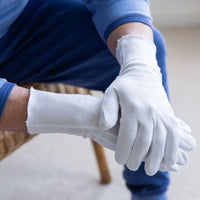
Cotton gloves provide a fabric barrier between fingernails and skin, which may help reduce scratching damage. Choose a comfortable fit. Gloves do not treat eczema or guarantee that scratching will stop.