

What You Wear to Bed Matters More Than You Might Think
When you're having a bad eczema night, the last thing you want is your pyjamas joining in.
You've moisturised. You've made the bedroom comfortable. You've finally got into bed.
Then you notice it.
A seam rubbing against an irritated patch of skin. A waistband that's suddenly far too noticeable. You're getting hotter underneath the covers. Or you've chosen shorts because you thought they'd keep you cool, only to realise you've now given yourself unrestricted access to scratch your legs.
For most people, choosing what to wear to bed isn't particularly complicated.
For somebody with eczema, it can be.
Nightwear sits against our skin for hours at a time, at exactly the point when eczema can become particularly itchy. So while the right pyjamas aren't going to cure eczema, choosing what you wear to bed carefully can remove some unnecessary irritation and potentially make a difficult night that little bit easier.
So, what should you actually wear?
Start With the Fabric
If there's one place to begin, it's here.
Eczema-prone skin generally doesn't appreciate being rubbed by rough, scratchy material. Some synthetic fabrics can also trap heat and moisture next to the skin, not particularly helpful if overheating and sweating are already triggers for you.
That's why we generally favour soft, breathable fabrics for eczema.
Organic cotton is particularly useful for nightwear because it's soft, breathable and comfortable against sensitive skin.
It's also worth thinking beyond what the label on the front of your pyjamas says.
Look at what's actually touching your skin.
Are there rough seams? Internal labels? Exposed elastic? Decorative stitching?
Something that seems insignificant when you're standing in a shop can become considerably more noticeable after six hours lying in bed.
We've looked at fabrics in much more detail in our article Material Matters – How What You Wear Affects Your Eczema.

Loose Isn't Always Better
This one can seem slightly counterintuitive.
If your skin is irritated, surely the loosest possible clothing is best?
Not necessarily.
Very loose nightwear can move around while you sleep, creating friction as the material repeatedly passes over irritated areas. Excess fabric can also bunch underneath you, creating uncomfortable folds and pockets of extra warmth.
At the other extreme, nobody wants skin-tight pyjamas digging into inflamed skin.
The sweet spot is somewhere in between.
Nightwear should generally be fairly close fitting without feeling tight or restrictive. You should be able to move comfortably while avoiding excessive fabric moving across the skin.
This is particularly important for children, who tend to move considerably more during the night than adults.
Should You Cover Eczema at Night?
Often, yes, particularly if scratching is a problem.
It can be tempting to expose irritated skin because it feels cooler, but uncovered skin also gives your fingernails direct access to it.
And unfortunately, your sleeping self isn't necessarily as disciplined as your daytime self.
You can spend an entire day resisting the temptation to scratch, fall asleep feeling very pleased with yourself and wake up the following morning wondering what on earth happened.
Covering affected areas with soft, breathable clothing creates a physical layer between your fingernails and your skin.
Long sleeves and full length bottoms can therefore be useful even when the weather isn't particularly cold.
Our Anti Scratch PJ Set is designed specifically around this problem, using 100% organic cotton alongside features intended to minimise irritation and scratching.
If unconscious scratching is something you struggle with, we've also explored why eczema sufferers scratch unconsciously through the night in our dedicated sleep article.
What if I Get Too Hot?
This is where things become a balancing act.
You want your skin covered.
But you don't want to overheat.
Heat and sweating can both make eczema considerably itchier for some people, which means piling on thick pyjamas and then climbing underneath a heavy duvet may defeat the purpose.
Rather than immediately removing your nightwear, think about the whole sleep environment.
Could you use lighter bedding?
Could the bedroom be cooler?
Would a lightweight cotton sheet be enough on a warm night?
Our own nightwear guidance recommends keeping people with severe eczema as cool as possible and, in some circumstances, using a cotton sheet or light cotton blanket rather than a heavy duvet.
There's even an old Eczema Clothing trick that we still love: keeping a spare set of nightwear or pillowcase in a bag in the fridge so you've got something cool and soothing available when you're particularly itchy.
It might sound slightly strange.
At 2am during a hot eczema flare, it can feel considerably less strange.
What Should Adults With Eczema Wear to Bed?
For adults with mild or moderate eczema, simple organic cotton pyjamas may be enough.
Look for:
-
Soft, breathable material
-
Long sleeves if your arms are affected
-
Full-length bottoms if your legs are affected
-
Flat or minimal seams
-
No irritating internal labels
-
A comfortable fit that isn't excessively loose
-
As little exposed elastic as possible
For more severe eczema or people who regularly scratch in their sleep, specialist nightwear can provide additional protection.
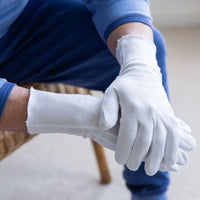
The Adult Eczema Scratch Mitten T has integral mittens to put a soft barrier between fingernails and skin overnight.
If you want access to your hands when needed, the Adult Eczema Scratch Mitten T Opening Hand provides another option.
The important thing is choosing according to your eczema rather than assuming everybody needs the same level of protection.

What Should Children With Eczema Wear to Bed?
Children can be particularly vulnerable to the night-time itch-scratch cycle because asking a sleeping three year old to exercise a bit more self-control isn't going to get you very far.
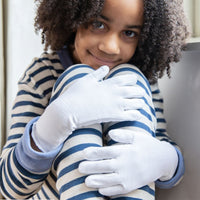
For younger children, covering both the skin and hands can be particularly useful.
Our Eczema Scratch Mitten PJ for ages 1–4 is an all-in-one design with integral mittens and feet. It's made from 100% organic cotton with flat seams and no internal labels.
For older children, separates can provide more flexibility.
The Kids' Eczema Scratch Mitten T combines organic cotton with integral mittens and a close-fitting neckline, while our Kids Anti Scratch PJ options provide fuller overnight coverage.
We've also broken our recommendations down by age on the Eczema Clothing website, because the most practical nightwear for a baby or toddler isn't necessarily the best solution for an older child.
Don't Forget What You're Sleeping Under
You can choose perfect nightwear and then undo some of that work with irritating bedding.
Your sheets spend just as much time against your skin as your pyjamas do.
Smooth, breathable cotton bedding can help reduce friction and overheating, while regularly washing bedding can remove the build-up of dead skin, creams and potential allergens such as dust mites.
It's also worth thinking about what you're washing both your bedding and your nightwear in.
Strong fragrances and residues from certain laundry products can irritate sensitive skin. Choosing a detergent your skin already tolerates and avoiding heavily fragranced fabric conditioners may help.
Our article Hot Tips for a Cool Restful Night goes into much more detail about bedroom temperature, bedding, allergens and washing your nightwear.
Your Nightwear Should Work With Your Eczema, Not Against It
There isn't one perfect eczema pyjama that everybody needs to wear.
Someone with mild eczema on their arms may need something completely different from a child with severe eczema who scratches throughout the night.
That's why we'd start with the problem you're actually trying to solve.
If friction irritates you: look for soft fabric, flat seams and a good fit.
If you overheat: choose breathable, lightweight material and reconsider how heavy your bedding needs to be.
If you scratch: consider keeping affected areas covered and using integral mittens where necessary.
If your eczema is severe: specialist nightwear that combines these features may be worth considering.
And if something you're wearing is clearly making your skin uncomfortable, listen to your skin.
Sometimes the Simplest Changes Help Most
Living with eczema can make bedtime surprisingly complicated.
You're thinking about creams. Bedroom temperature. Bedding. Scratching. Dust mites. Whether you're too hot. Whether you're too cold.
Your pyjamas don't need to become another complicated decision.
Start simple.
Choose something soft.
Choose something breathable.
Make sure it fits comfortably.
Cover areas you tend to scratch.
And avoid anything that makes your skin hotter, rougher or more irritated than it already is.
The right nightwear won't cure eczema.
But when you're trying to get through an itchy night, removing one more reason to scratch can make a surprisingly big difference.
And sometimes that's exactly what you need to finally get some sleep.